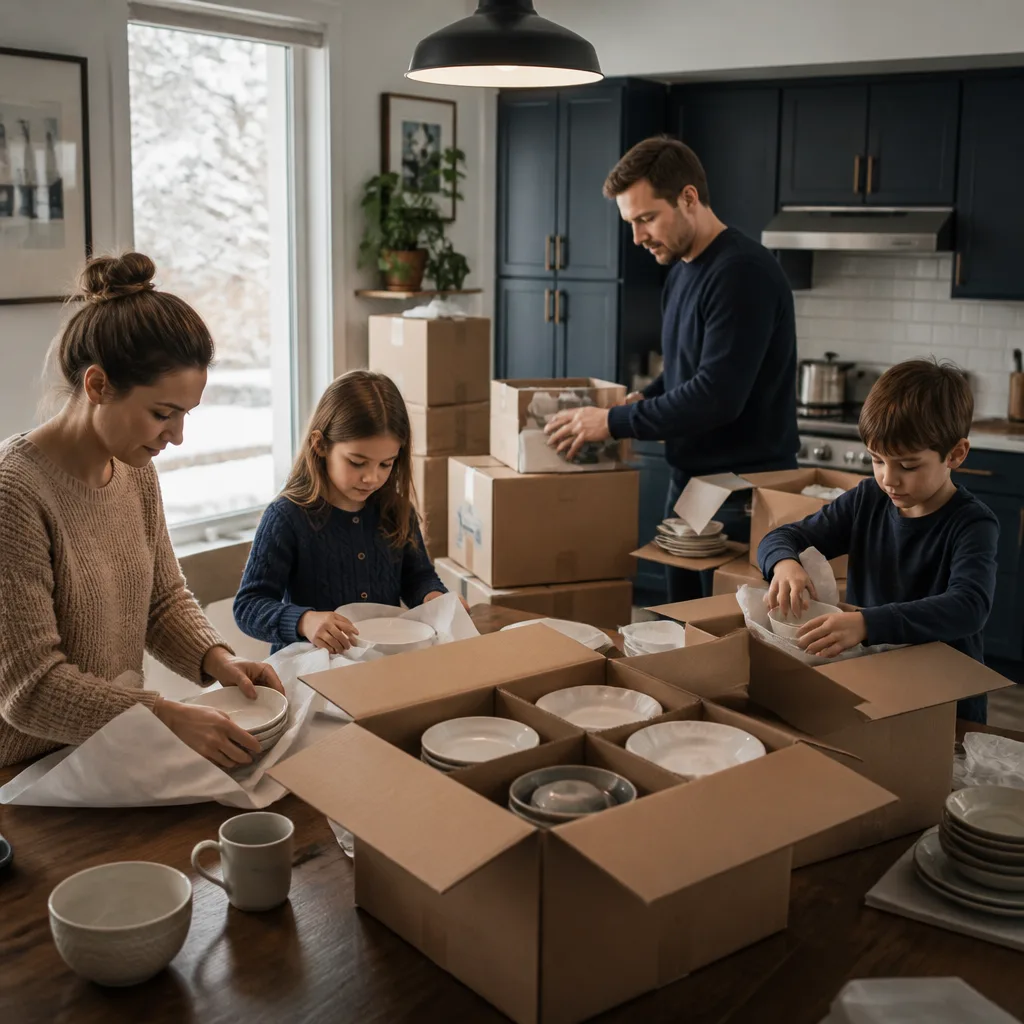
If you are moving within Ottawa, Kanata, Orleans, Nepean, Barrhaven, Gatineau or elsewhere in the National Capital Region, packing decisions affect more than the number of boxes. They influence loading order, arrival-day setup, elevator and parking coordination, and how clearly your estimate describes the job. This guide helps you choose the right level of packing without repeating a generic box-by-box checklist. For a room-level packing sequence, see our Ottawa moving and packing tips; for move-day readiness, use the home preparation checklist.
Start with the outcome, not the package name
Moving companies may use terms such as full packing, partial packing, fragile-only packing, or customer-packed. Those labels are not a complete scope by themselves. One company’s “partial pack” might cover dishes and artwork; another may include the kitchen, bookshelves, and selected rooms. Ask what workers will pack, what remains your responsibility, whether packing materials are included, and how the work will be priced.
Make a short inventory before you request estimates. Separate ordinary household goods from items that require special handling: framed art, mirrors, lamps, glass shelves, musical instruments, electronics, collections, and unusually heavy or awkward pieces. Identify items that will not go on the truck, such as medications, important documents, daily-use devices, valuables, and anything a carrier excludes. Confirm the carrier’s restricted-item list in writing rather than relying on a general internet list.
The practical question is: which tasks would you confidently complete yourself, and which ones would be rushed or risky if left until the final days? A household with time, few fragile possessions, and easy access may self-pack most goods. A busy household with a large kitchen, limited evenings, or extensive breakables may get more value from help in those specific areas.
Compare three packing approaches
| Approach | What it typically means | Best fit | What to confirm |
|---|---|---|---|
| Self-packing | You source supplies, pack, and label your cartons | Flexible schedules and hands-on control | Packing deadline, carton standards, exclusions |
| Partial packing | Crew packs agreed rooms or fragile items; you pack the rest | Kitchens, artwork, glassware, time-sensitive moves | Exact rooms/items, materials, start time |
| Full-service packing | Crew packs most agreed household contents | Larger moves, limited time, complex inventories | Included items, unpacking scope, materials and price |
These are planning categories, not a promise that every mover offers the same menu. Request a line-by-line description. If packing and moving are on separate dates, ask how the extra visit affects the schedule and estimate. If you are considering a professional packing service in Ottawa, compare the scope, materials and arrival plan alongside the cost—not only the package label.
When self-packing makes sense
Self-packing can work well when you have enough lead time, can obtain suitable materials, and are willing to organize the work by room. It gives you direct control over what goes into each carton and when. It also makes it easier to declutter as you pack, donate items, and keep a precise separation between belongings for the mover and belongings travelling with you.
The trade-off is responsibility. You need enough cartons in suitable sizes, clean cushioning, strong tape, labels, and a plan for items that are fragile, heavy, oddly shaped, or not accepted by the carrier. Loose or overfilled boxes take longer to handle and may be harder to stack safely. A carton marked “kitchen” is less useful at the new home than one marked “kitchen—everyday plates” with an indication of which side stays upright.
Self-packing also requires an honest time estimate. People often count boxes but forget pantry sorting, drawers, shelves, lampshades, décor, basement storage, and the last-used items that stay out until the final night. Begin with storage areas and objects you rarely use. Keep a small, clearly marked “do not load” area for essentials and tell the crew about it during the walkthrough.
When partial packing is the balanced choice
Partial packing is useful when the household can manage routine items but wants help with work that is delicate, repetitive, or easy to underestimate. The kitchen is a common candidate because it combines many shapes and materials, and because everyday dishes remain in use until close to moving day. Artwork and mirrors may also need specific cartons or edge protection. Bookshelves and decorative collections can consume more time than their size suggests.
The key is to agree on a boundary. Create a written room list and mark any items that are self-packed, mover-packed, or travelling separately. Photograph the agreed inventory if it helps both sides. Decide whether the crew will pack drawers, closets, cupboards, or only loose objects. Confirm how they will handle open containers, liquids, food, plants, and items that need to be disconnected.
Partial service can fail when the division of work is vague. If the mover arrives expecting clear floors and sealed boxes but you expect the crew to finish the remaining rooms, the crew may need to revise the plan. Clarify the completion deadline, what happens if the agreed packing is not ready, and whether the crew will pack additional items only after approval. A short confirmation email prevents moving-day assumptions from turning into delay.
When full-service packing can reduce friction
Full-service packing is most useful when protecting your time is as important as limiting the number of tasks you personally perform. It may suit a household with a tight closing schedule, a large inventory, mobility constraints, work or caregiving responsibilities, or several fragile rooms. It can also make sense when the move involves a long drive and you want cartons prepared for a planned loading sequence.
Full service does not mean every object disappears into a box without your involvement. You still need to identify what travels, what is donated, what stays with you, and what requires special handling. Separate confidential papers, jewellery, cash, passports, prescriptions, keys, chargers, and the first-night essentials before the crew starts. Point out fragile, high-value, or previously damaged items and ask how those will be noted on the inventory.
Ask if packing happens on moving day or the day before. Packing and loading at once may be efficient for a small home, while a larger property may need a separate pack day. Confirm who supplies cartons, specialty containers, paper and protective wrap; what happens to unused supplies; and whether unpacking or debris removal is included or separate. Do not assume “full service” includes furniture disassembly, appliance disconnection, disposal, or setup.

Estimate effort and cost without guessing
Packing estimates vary with the amount of goods, the rooms included, fragility, access, materials, crew size, and whether packing is scheduled separately from transport. A phone estimate based only on the number of bedrooms can miss a packed garage, a full basement, built-in shelving, a large book collection, or a high-rise elevator booking. Share a complete inventory and request a survey when the home or scope is substantial.
Compare written proposals using the same inventory and same assumptions. Ask whether the price is hourly, fixed, or a combination; how minimum time and travel are handled; what materials are included; and which changes can adjust the amount. The federal Office of Consumer Affairs moving advice recommends obtaining multiple estimates and checking the details rather than relying only on the lowest number.
To make an hourly move more predictable, finish the tasks you have agreed to do before the crew arrives. Label cartons by destination room, keep pathways clear, reserve the elevator and loading space where needed, and have building rules ready. For condos and apartments, call property management early about move windows, deposits, loading-dock access, and protection requirements. Ottawa neighbourhoods vary: a downtown loading zone, a suburban driveway, and a narrow shared lane create different arrival constraints.
Protect fragile and high-value belongings
Packing quality comes from a system: suitable container, cushioning, stable arrangement, clear label, and handling instructions. Wrap breakables individually and fill voids so items cannot shift. Avoid mixing dense books with delicate items in one oversized carton. Place heavier goods in smaller boxes so they remain manageable, and don’t let a box’s strength depend on one layer of tape.
For electronics, photograph cable connections before unplugging and keep small components together in labelled bags. Use original packaging when it is intact and appropriate; otherwise ask the mover what protective carton they recommend. Artwork, mirrors and glass tabletops may need specialty cartons or crating, so include dimensions and photos in your estimate request. Ask the mover to record visible pre-existing damage on the inventory and to explain its claims and valuation process before the move.
The Canadian Association of Movers provides consumer resources and guidance on working with professional movers. Read the carrier’s own terms too: insurance, valuation, exclusions, and claim deadlines differ. Do not pack hazardous materials or items the mover has said it will not carry. For prescriptions, identity papers, jewellery, laptops, and irreplaceable personal items, keep them with you unless you have confirmed a documented secure handling arrangement.
A practical four-stage packing schedule
Four to six weeks before Declutter room by room and decide which items are moving. Request estimates with an honest inventory. Reserve the date, building elevator, loading area, and any parking permits that apply. Gather documents about special items and confirm the mover’s packing options, exclusions, and material policy.
Two to three weeks before Pack seasonal items, books you will not need, décor, spare linens, and storage contents. If the crew is packing only selected rooms, agree on the exact list now. Arrange donation or disposal of items not moving, following municipal rules for household waste and hazardous products.
Final week Finish most self-packed cartons, leaving a small set of daily-use items open. Label every carton with destination room and a useful contents description. Confirm the arrival time, building access, packing start time, and contact person. Keep the “not for truck” items together and visible.
Moving day Walk through the home with the crew lead. Point out fragile items, the no-load area, cartons requiring upright handling, and any access issues. Confirm the inventory before loading begins. Keep children and pets safely away from work zones and retain your moving documents, keys, medication, and essentials.
The packing decision in four questions
- 1Time available
Can the household finish safely before the mover's deadline?
- 2Item risk
Which fragile, valuable, or awkward pieces need experienced handling?
- 3Scope clarity
Can you define who packs each room and what stays with you?
- 4Arrival plan
Will cartons, access, elevator, and loading sequence be ready?
Match packing to the move itself
For a short local move, unpacking may begin the same day, so room labels and an essentials carton matter immediately. For an interprovincial move, ask how cartons are inventoried, protected from weather, and matched to the delivery plan. If packing is split across days, keep the completed rooms closed and the remaining work clearly separated. If storage is involved, identify items that must be accessible first and confirm whether the storage provider permits the materials or goods being held.
People relocating from Ottawa to Toronto, Montréal, Calgary, Vancouver, or another Canadian destination should confirm both ends of the move: access at origin and destination, delivery date range, parking, stairs or elevators, and who can receive the shipment. A long-distance move may include coordination beyond a single crew’s local arrival window. Discuss how a changed closing date, delayed key handover, or destination access issue affects delivery and storage before signing.
If you want to compare options, ask a mover for a written scope and ask the same questions of each provider. Prestige Moving’s Ottawa moving services are one example to include when reviewing local packing and moving options; confirm current service availability, dates, and scope directly with the provider. For the company’s specific long-distance option, see its long-distance moving service.
Frequently Asked Questions
Is professional packing worth it for a local Ottawa move? It depends on your schedule, the inventory, and how much fragile or awkward work you have. Compare the written packing scope with the hours and materials you would need to provide yourself. Partial packing may be a practical middle ground.
### Can I pack some rooms and have the movers pack the rest? Often, yes, but confirm that the provider offers partial packing and identify the exact rooms and items in writing. Ask how extra packing is approved and billed if the agreed work is incomplete.
Can I pack some rooms and have the movers pack the rest? Often, yes, but confirm that the provider offers partial packing and identify the exact rooms and items in writing. Ask how extra packing is approved and billed if the agreed work is incomplete.
### Should I pack dishes and artwork myself? You can, if you have suitable materials and time, but ask the mover about its packing standards, specialty cartons, and handling requirements first. For valuable or unusually shaped items, share photos and dimensions before booking.
Should I pack dishes and artwork myself? You can, if you have suitable materials and time, but ask the mover about its packing standards, specialty cartons, and handling requirements first. For valuable or unusually shaped items, share photos and dimensions before booking.
### What should I keep out of the moving truck? Keep medications, essential documents, valuables, keys, daily-use electronics, and first-night supplies with you. Ask the selected mover for its current prohibited and restricted-item list.
What should I keep out of the moving truck? Keep medications, essential documents, valuables, keys, daily-use electronics, and first-night supplies with you. Ask the selected mover for its current prohibited and restricted-item list.
### How far ahead should I arrange packing help? Book once your move date and building access are reasonably clear, especially for month-end and summer dates. Earlier scheduling leaves more room to survey the inventory and agree on a clear packing scope.
How far ahead should I arrange packing help? Book once your move date and building access are reasonably clear, especially for month-end and summer dates. Earlier scheduling leaves more room to survey the inventory and agree on a clear packing scope.
### Does a full packing service include unpacking? Not necessarily. Packing, unpacking, debris removal, furniture assembly, and appliance work may be separate services. Request a written list of included and excluded tasks.
Does a full packing service include unpacking? Not necessarily. Packing, unpacking, debris removal, furniture assembly, and appliance work may be separate services. Request a written list of included and excluded tasks.
## Choose a scope you can explain in one page